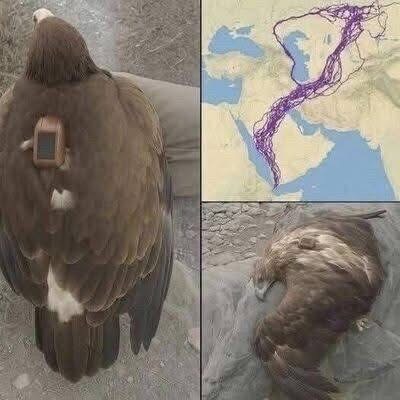
For two decades, a single eagle carried a silent witness on its back—a GPS tracker that transformed the bird from a biological subject into a source of profound scientific bewilderment. While its peers followed the ancient, rhythmic pulse of seasonal migration, this eagle carved a chaotic, jagged path across continents, defying every rule in the avian playbook. As researchers watched the data points accumulate, the bird’s movements began to look less like survival and more like a deliberate, cryptic message…
that refused to be decoded. The eagle didn’t just fly; it doubled back over scorched deserts, lingered in desolate mountain passes for no apparent reason, and veered into oceanic stretches that should have been death sentences. For years, the team of scientists sat in their labs, staring at maps that looked like the frantic scribbles of a madman. They questioned everything: Was the bird sick? Was the technology failing? Or were they witnessing a fundamental flaw in their understanding of the natural world?
The pressure to find an answer mounted as the years turned into a decade. Every time the bird veered off-course, it challenged the core tenets of ornithology. The scientific community began to whisper about the “erratic eagle,” a creature that seemed to exist in a state of perpetual, aimless wandering. Yet, the bird survived. It thrived in places where it should have perished, and it navigated with a precision that suggested it wasn’t lost at all—it was simply playing a game the humans hadn’t yet learned the rules to.
The breakthrough didn’t come from a new piece of technology, but from a shift in perspective. Researchers stopped looking at the eagle as an isolated entity and started looking at the world through its eyes. By layering the bird’s flight paths over hyper-local weather data, wind currents, and subtle topographical shifts, the chaos finally began to bleed into clarity. They realized the eagle wasn’t wandering; it was dancing with the invisible architecture of the planet.
Leave a Reply