Melania Trump has once again found herself at the center of public attention—this time over royal etiquette and a striking designer gown that quickly became the focal point of conversation.
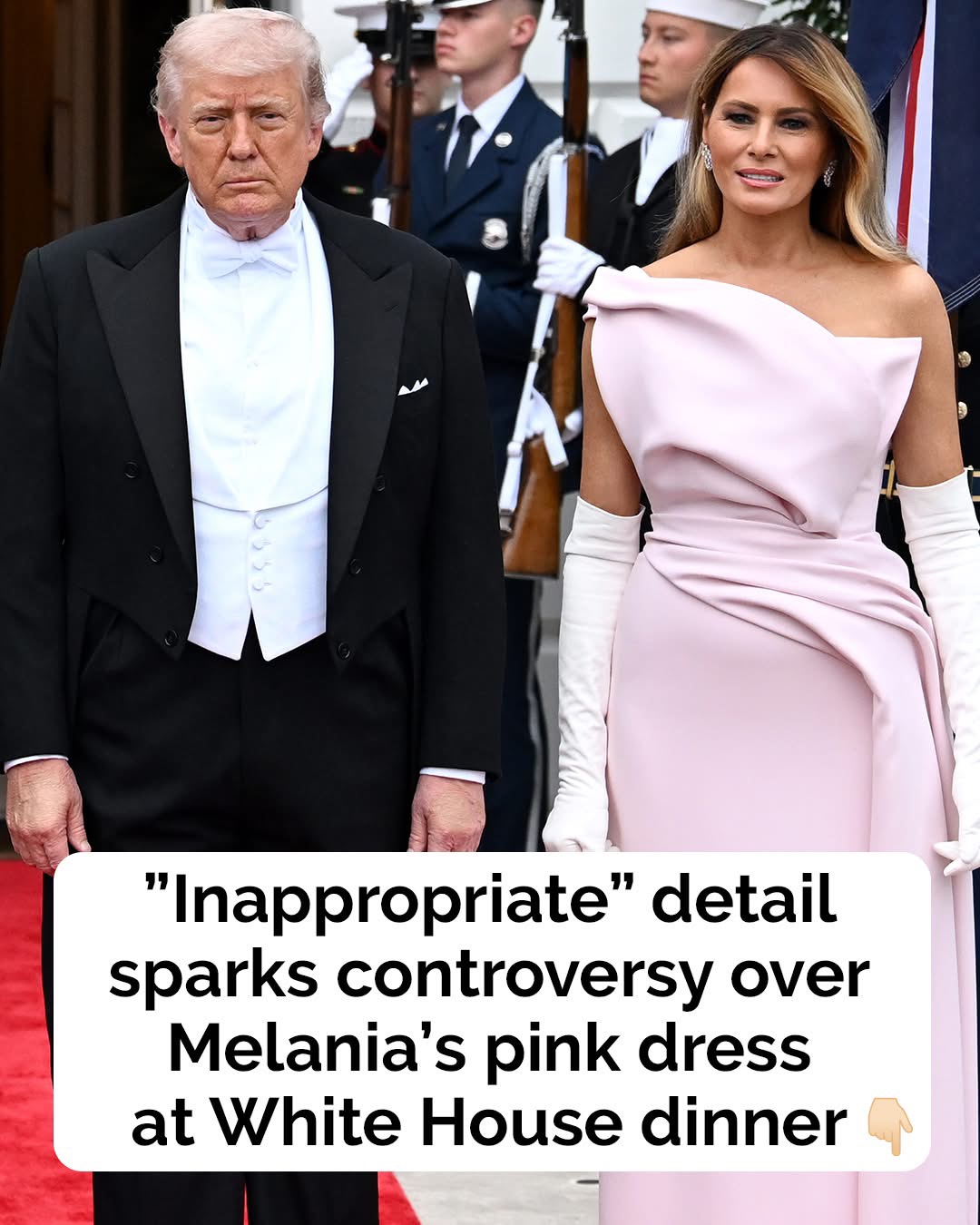
During a formal state dinner at the White House on April 28, held in honor of King Charles III and Queen Camilla, the First Lady appeared in a soft pink, strapless Christian Dior Haute Couture gown reportedly valued at around $80,000. The look immediately drew attention—not only for its craftsmanship but for how it fit within the expectations of a traditional white-tie event.
For some observers, the gown was refined and elegant. For others, it raised questions about whether it aligned with the long-standing conventions typically associated with royal state banquets.
In British tradition, such events follow one of the strictest dress codes—white tie. For men, that usually means a black tailcoat, white bow tie, and formal accessories that reflect rank or honors. For women, the expectation leans toward full-length gowns with structured silhouettes, often paired with a modest presentation that historically includes covered shoulders.
Color has also played a subtle but consistent role. White has often been favored at royal banquets, symbolizing tradition and formality. Notably, both Melania and Ivanka Trump chose white gowns during a previous state dinner at Buckingham Palace in 2019, echoing a pattern followed by figures such as Michelle Obama.
Against that backdrop, Melania’s choice of a pink, shoulder-baring gown stood out. The design featured a sculpted bodice and a clean, flowing line, paired with off-white gloves and pale heels—an ensemble that leaned toward high-fashion interpretation rather than strict adherence to convention.
Reactions came quickly and from all sides.
Some viewers praised the look as sophisticated and beautifully executed, noting the precision of the tailoring and the confidence it projected.
“Imagine a dress so perfectly tailored that the hem skims the floor without being a fraction too long or short. Beautiful,” one person wrote.
Others, however, were less convinced, questioning both the structure and the suitability of the design for such a formal diplomatic occasion.
“Can’t say I love that dress Melania is wearing… I don’t understand the structure of it, normally I love her choices,” another commented.
“Melania is gorgeous, but this pink dress is odd,” a third added.
A few critics went further, suggesting that certain styling choices felt out of place within the context of a state visit, while others defended the outfit as a modern take on formalwear that reflects evolving standards.
Category: Uncategorized
-
The one detail critics can’t stop talking about in Melania’s pink dress
-

King Charles’ Congress speech gets standing ovation after bombshell ‘swipe’ at Trum
King Charles III delivered one of the most closely watched moments of the state visit during his address to the U.S. Congress, an appearance that carried both ceremonial weight and quiet diplomatic intent. While the speech was framed around unity and shared history, it quickly drew attention for how it was interpreted—particularly in relation to Donald Trump and current geopolitical tensions.
The visit itself comes at a delicate time. Relations between the United States and the United Kingdom have been strained by disagreements over foreign policy, including the situation involving Iran and differing approaches toward the war in Ukraine. Against that backdrop, the presence of the British monarch in Washington has been widely seen as an effort to reinforce stability between longstanding allies.
During his speech, King Charles leaned heavily on history to underscore that relationship. He referenced moments when both nations stood together, including the aftermath of the September 11 attacks, when NATO allies invoked collective defense for the first time. By highlighting that unity, he emphasized a broader theme: that cooperation has been the defining strength of the transatlantic partnership.He extended that argument into the present, noting that similar resolve is needed today—particularly in supporting Ukraine and maintaining collective security. The message itself aligned with established Western positions, but the context made it more significant. At a time when divisions have emerged over strategy and priorities, even a general call for unity can carry political weight.
This is where interpretations began to diverge. Some observers described the remarks as a subtle critique of current U.S. leadership, suggesting that the emphasis on alliance solidarity indirectly contrasted with recent rhetoric from Washington. Others viewed it more traditionally—as a diplomatic reaffirmation rather than a pointed challenge.
The standing ovations that followed parts of the speech added another layer to the moment. In Congress, such reactions often reflect not just agreement with specific lines, but broader approval of tone and message. In this case, the response appeared tied to the speech’s emphasis on shared values, historical continuity, and collective responsibility.
Online reactions, however, were far less uniform. Supporters praised the address as measured, dignified, and clear in its defense of alliances like NATO. Critics or skeptics questioned whether the speech was being over-interpreted, arguing that the monarch’s role is inherently neutral and not designed for political confrontation.
That tension between interpretation and intention is central to understanding the moment. The British monarchy operates within strict conventions, avoiding direct political statements while still engaging in global conversations through symbolism and carefully chosen language. Political leaders, by contrast, often frame events more explicitly, which can create mismatched narratives about what was actually said or implied.
In practical terms, the speech did what such addresses are meant to do: reinforce the idea that, despite disagreements, the U.S. and U.K. remain closely connected. Whether it was perceived as a “dig” or simply a reminder depends largely on the listener’s perspective.What remains clear is that the address resonated beyond the chamber itself. It became part of a wider discussion about leadership styles, alliance expectations, and the role of diplomacy in a period marked by uncertainty.
-

The dog ran into the hospital with a huge black garbage bag on its back: the nurses tried to drive it away, until one of them noticed something strange in its behavior
That day, the emergency room was strangely quiet. Outside, heavy rain poured down so hard the streets were almost invisible. Water streaked across the windows, and only a few soaked visitors came through the automatic doors. Inside, the nurses moved slowly—some filling out paperwork, others checking charts—just trying to get through the long shift.
Then the silence shattered.Loud, urgent barking echoed through the room. At first, no one knew where it was coming from. But suddenly, the doors swung open—and a dog ran inside. A large German Shepherd, drenched from the rain, with a heavy black bag strapped to its back.
The security guard rushed forward.
“Hey! Stop!”But the dog ignored him completely. It moved with purpose, heading straight toward the reception desk, leaving wet paw prints behind.
One nurse jumped up.
“Who let that dog in? Get it out of here!”Others backed away nervously, waving their hands to scare it off. The guard tried to grab its collar.
“You can’t be in here!”But the dog didn’t retreat. It stood firm, barking loudly, breathing hard—as if it was trying to communicate something. When people got too close, it only stepped aside, never running away. Its eyes looked tense… almost desperate.
The staff kept trying to drive it out. Someone was about to call for help.It managed to pull the child from the car, placed it in the bag, and somehow made its way through the rain and darkness to the nearest hospital.
Because of that… the child survived.
And soon after, the parents were found and brought in time for treatment too.
-
If You Spot a Painted Purple Fence, This Is What It Means
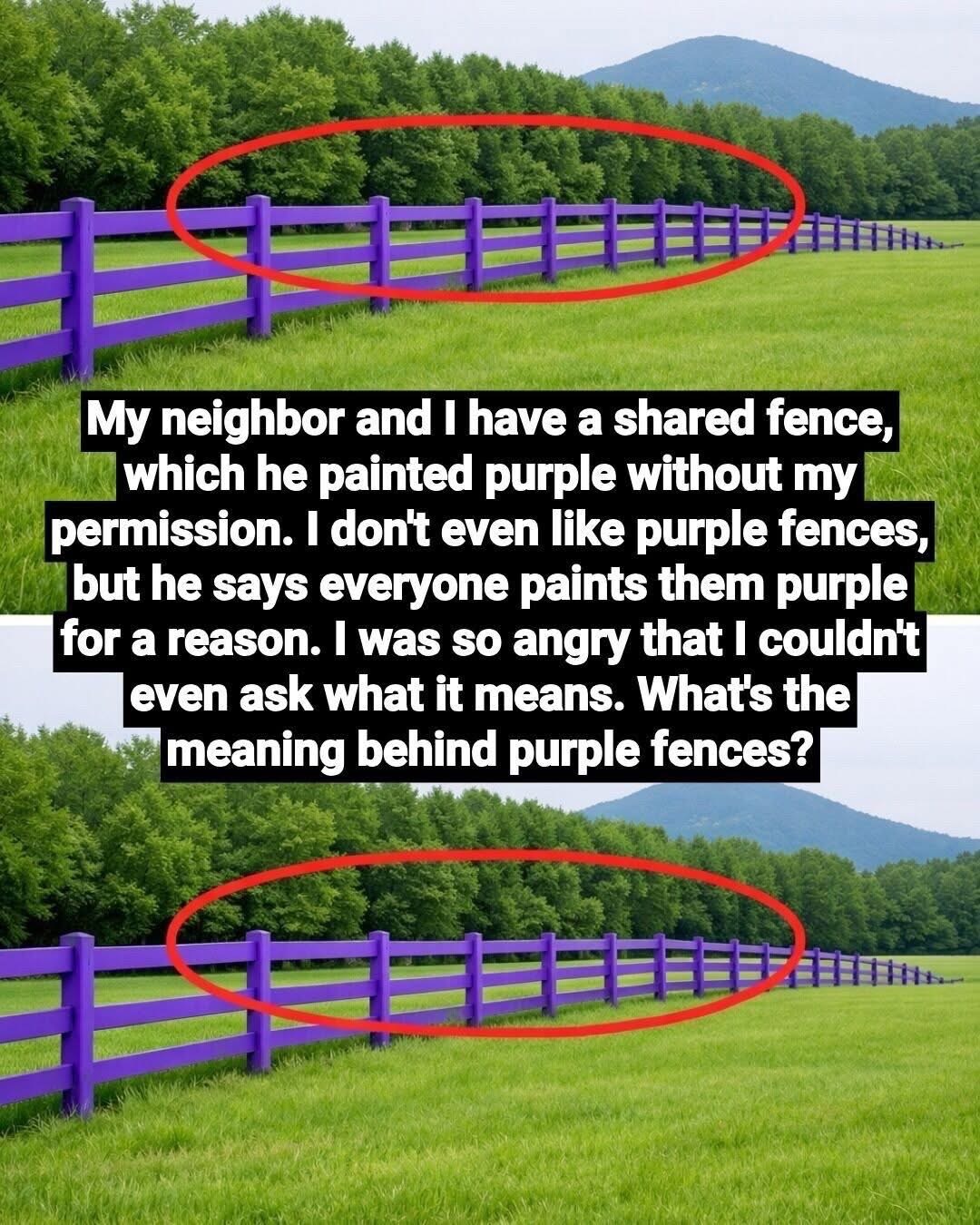
In many U.S. states—particularly across the South, Midwest, and rural West—purple paint on trees, fence posts, or rocks isn’t decorative. It’s a legal “No Trespassing” sign.
This practice, known as the “Purple Paint Law,” is officially recognized in at least 18 states, including Texas, Arkansas, Missouri, North Carolina, Illinois, and Florida. The idea is simple: in large, remote properties (like farms, ranches, or timberland), it’s impractical to post traditional “No Trespassing” signs every few hundred feet. Instead, landowners use vertical purple paint marks as a durable, weather-resistant alternative.While exact rules vary by state, most follow these guidelines:Paint marks must be vertical (not horizontal or splattered)
Length: Typically 8–12 inches long
Height: 3–5 feet off the ground
Spacing: Marks placed every 100–1000 feet along the boundary (depending on state law)
Color: Must be purple (specifically “blaze purple”—a shade visible in most lighting conditions)
📌 Example: In Texas, under Penal Code §30.06, purple paint marks carry the same legal weight as a “No Trespassing” sign. Ignoring them can result in criminal trespass charges, even if no signs are present.❓ Why Purple?
Great question! Several practical reasons:Highly visible year-round—even in snow, mud, or dense foliage
Uncommon in nature, so it stands out (unlike red, which could be rust or clay)
Not used for other property markings (blue = pipeline, orange = survey, etc.)
Long-lasting paint resists fading better than many colors
🚫 Does It Apply Everywhere?
No. If you’re in a state without a purple paint law (like California, New York, or most of New England), purple markings have no legal standing. Always check your local statutes.But in states where it is law—ignorance isn’t a defense. Hunters, hikers, and even drone operators have been cited for trespassing based solely on purple paint.
-

Defeating A Cruel Algebra Teacher Taught My Son A Valuable Lesson
My teenage son Sammy returned home from high school incredibly frustrated and closed his bedroom door. Knowing he needed comfort after a difficult day, I carried a bowl of freshly baked chocolate treats into his room and sat on the edge of his bed. He eventually sat up and explained through tears that his classmates had cruelly laughed at him for failing his math test. He expressed a deep hatred for algebra and claimed he disliked the subject even more than our eccentric Aunt Ruby from Texas. I realized the best way to comfort his wounded spirit was to share a ghost from my own academic past. I explained to Sammy that my high school algebra teacher had made it her personal mission to convince me I was incapable of learning. Mrs Keller was a legend at the school but frequently used her influence to mock my questions and publicly suggest I lacked basic intelligence. She effectively silenced me for months until I finally reached my breaking point on a Tuesday in March and asked her to stop humiliating me. Instead of apologizing, she pulled out a flyer for the district math championship and challenged me to represent the school. She entirely expected me to fail publicly and prove her cruel point to the rest of the class.
-

Wow Thanks to this trick your house will never stop smelling: 2 ingredients are enough 𝗖𝗵𝗲𝗰𝗸 𝟭𝘀𝘁 𝗰𝗼𝗺𝗺𝗲𝗻𝘁🤔👇 👇👇….
Thanks to this trick your house will never stop smelling: 2 ingredients are enough
Tired of synthetic air fresheners or expensive candles? There’s a simple, natural, and incredibly effective trick used by grandmothers and homemakers for generations to keep homes smelling fresh all day long—using just two pantry staples.
🔥 How It Works: The Simmer Pot Method
This old-fashioned technique fills your home with a soft, comforting aroma that’s subtle yet lasting—like freshly baked cookies, without the sugar crash.
What You’ll Do:
Pour 2 cups of water into a small saucepan.
Add 2–3 teaspoons of pure vanilla extract.
Bring to a gentle simmer on the stove over low heat.
Let it simmer 1–2 hours, adding more water as it evaporates.Vanilla is a natural odor neutralizer—it doesn’t just mask smells; it helps eliminate them.
The warm steam carries the scent gently through your home, clinging to fabrics and lingering for hours.
Unlike artificial fragrances, vanilla is calming—studies show it can even reduce anxiety!
🕯️ Bonus Variations (Still Only 2 Ingredients!)
Want to switch it up? Try these equally simple combos:
Lemon + Water: Bright, clean, and energizing
Cinnamon sticks + Water: Warm and spicy (simmer 2–3 sticks)
Peppermint extract + Water: Refreshing and crisp (great in summer)❤️ The Heart of the Trick
This isn’t just about scent—it’s about creating a feeling. That warm, safe, “someone loves you” smell that makes guests sigh and say, “Your house always smells so good!
So grab your saucepan, pour in that water, and add a splash of vanilla. In minutes, your home won’t just smell clean—it’ll smell like love, comfort, and care. -

My Parents Took Me To Court For Buying My Own House Then Everything They Hid Came Out In One Room
The day I was served legal papers on my own front porch was the day everything finally stopped pretending to make sense.
I had just come back from the hardware store, hands dusty, clothes marked with paint and drywall. The house still needed work, but that didn’t bother me. It was mine. Every inch of it had been earned, slowly, deliberately, without shortcuts or help.
Six months earlier, I had signed the papers alone.
No co-signer. No family support. No safety net.
Just me.
I barely had time to set my tools down before I heard someone behind me.
“Anna J. Wear?”
I turned to see a man in a suit, expression neutral, detached. He handed me an envelope like it meant nothing.
“You’ve been served.”
Then he left.
Just like that.
No explanation. No hesitation.
I stood there staring at the envelope, already knowing something was wrong before I even opened it. It felt heavy in my hands, official in a way that made your chest tighten before your brain catches up.
I opened it slowly.Read it once.
Then again.
Then a third time because it didn’t make sense.
Patricia and Daniel Wear versus Anna J. Wear.
My parents.
They were suing me.
The words blurred at first, then sharpened into something almost unreal. Fraud. Unjust enrichment. Breach of familial duty. Interference with opportunity.Legal language trying to dress up something much simplerNo way to pretend it was fair.
And sitting there, listening to them struggle to answer something so simple, I realized something I should have understood years ago.
This was never about what I did.
It was about what I refused to be.
I wasn’t the daughter who needed saving.
I was the one who proved I never needed them at all.
And that was the one thing they could never accept