
Blog

  • The Neon Retribution: A Lesson in Boundaries and Bridal Shine-

    The Neon Retribution: A Lesson in Boundaries and Bridal Shine-

    The conflict erupted when Denise, a mother-in-law who had bypassed babysitting duties for nearly a decade, suddenly volunteered to care for her sick eight-year-old granddaughter, Theresa. Despite explicit instructions from the mother that no haircuts were to take place, Denise waited for the house to empty before executing a quiet act of domestic betrayal. By the time the mother rushed home in response to a frantic, sobbing phone call from her daughter, the damage was already done: Theresa’s signature long golden curls were scattered across the kitchen floor, discarded by a grandmother who valued “presentable” appearances over the child’s trust and the mother’s clear boundaries.
    The subsequent confrontation was defined not by an explosion of rage, but by a calculated and chilling documentation of the violation. Denise remained entirely unrepentant, humming as she swept up the hair and explaining that she had simply “fixed” a messy situation in preparation for upcoming family wedding photos. While the mother consoled her traumatized daughter—who had been manipulated into believing the haircut was her mother’s idea—the grandmother dismissed the entire ordeal as a trivial matter of “just hair.” This dismissal of bodily autonomy and parental authority set the stage for a retaliatory lesson designed to target the one thing Denise valued most: her own vanity.

    The incident served as a permanent marker for the family, demonstrating that while hair may grow back, the sanctity of a child’s trust and parental boundaries are non-negotiable

  • Mysterious “Ghost Photo” Goes Viral on Social Media

    A black-and-white photograph circulating on social media has sparked widespread curiosity and debate after being labeled as a “real ghost photo.” The image, which appears to show four individuals posing formally, has drawn attention due to what some viewers claim is an unusual and unexplained presence within the frame.

    The photo gained traction after being featured in a short video clip on social platforms, where a narrator suggested that one of the figures or details in the background may not belong, fueling speculation about paranormal activity.

    However, experts and skeptics point out that such images are often misinterpreted. Factors like poor image quality, lighting conditions, and aging of old photographs can create illusions that appear mysterious or supernatural. In many cases, these effects are explained by natural causes rather than evidence of ghosts.

    Despite the lack of concrete proof, the image continues to circulate widely, captivating audiences and reigniting discussions about the possibility of the paranormal.

    As of now, there is no verified evidence confirming the presence of anything supernatural in the photograph.

  • Honoring the Life and Legacy of a Country Music Legend at 85

    The news hit like a broken chord in a silent room. A beloved country legend, Jeannie Seely, gone after a year of relentless health battles and unbearable grief. Fans sensed something was wrong, but few knew how bad it had become. ICU nights. A shattered heart after losing her husband.

    A final, quiet goodbye that left the Opry in tea…She spent a lifetime turning pain into poetry, standing under hot stage lights while singing the stories other people were too afraid to tell. From smoke-filled honky-tonks to the sacred circle of the Grand Ole Opry, Jeannie Seely carried herself with a mix of grit and grace that made strangers feel like family. Her voice didn’t just entertain; it steadied people through heartbreak, war, loss, and lonely midnight drives home.

    In her final year, the spotlight dimmed but her courage did not. Even as doctors fought for her life and grief pressed in after her husband’s death, she remained a quiet source of strength for those around her. Now, the microphone stands empty, but the echoes of her songs linger in living rooms, pickup trucks, and old radios. Her legacy isn’t just in the records she made, but in the hearts she helped keep beating.

  • A Quiet Giant Falls

    A Quiet Giant Falls

    When Charles Rangel walked the halls of Congress, he did so with the bearing of someone shaped long before Washington by Harlem streets and wartime service. His passing at 94 marks the end of one of the longest and most consequential congressional careers in modern American history.
    Rangel was first elected to the U.S. House of Representatives in 1970, representing New York’s 13th Congressional District — a seat he held for nearly five decades. A decorated Korean War veteran, he brought to public office a perspective grounded in both military service and the lived realities of the community that raised him.

    For Rangel, issues such as civil rights, affordable housing, healthcare access, and economic opportunity were not abstract policy debates. They were rooted in the everyday struggles of his constituents. Throughout his tenure, he focused on legislation aimed at job creation, urban investment, and expanding opportunity in underserved communities.

    As a founding member of the Congressional Black Caucus and later chair of the powerful House Ways and Means Committee, Rangel played a significant role in shaping tax policy and social legislation. His influence extended beyond party lines, even as he remained a steadfast Democrat.

    Colleagues often described him as both forceful and personable — someone who could argue intensely on the House floor and share stories moments later. He frequently reminded younger lawmakers that public office was a responsibility entrusted by voters, not a platform for personal visibility.

    His long career was not without controversy; like many figures who serve for decades, he faced ethics investigations later in life. Yet his supporters argue that his broader legacy rests on sustained advocacy for urban communities and expanded political representation.

    With his death, Congress loses one of its last links to a generation of lawmakers shaped by the civil rights movement and postwar America. His career spanned eras of dramatic political transformation, from the 1970s through the 2010s.

    Charles Rangel’s legacy will ultimately be measured not only by committee leadership or legislative milestones, but by the communities he represented for nearly half a century — and the imprint he left on the institution of Congress itself.

  • A short-form video circulating on social media is drawing attention for its focus on the most intense types of pain the human body can experience. The clip, labeled “Worst Pains the Human Body Can Experience – Part 4,” features a presenter explaining and highlighting some of the most severe physical conditions known for causing extreme discomfort.

    Set against a digital background showing the human skeleton and spine, the video appears to be part of an ongoing series aimed at educating viewers about medical conditions associated with high levels of pain. While the exact conditions discussed in this segment are not specified in the image alone, similar content often includes examples such as kidney stones, severe burns, or nerve-related pain.

    The video has gained traction online, with users engaging in discussions about personal experiences and the accuracy of such rankings. Experts generally note that pain perception can vary widely from person to person, depending on individual tolerance and medical circumstances.

    As health-related content continues to trend on social platforms, viewers are encouraged to approach such videos with curiosity, while also relying on professional medical advice for accurate information.

  • A Quiet Giant Falls

    A Quiet Giant Falls

    When Charles Rangel walked the halls of Congress, he did so with the bearing of someone shaped long before Washington by Harlem streets and wartime service. His passing at 94 marks the end of one of the longest and most consequential congressional careers in modern American history.
    Rangel was first elected to the U.S. House of Representatives in 1970, representing New York’s 13th Congressional District — a seat he held for nearly five decades. A decorated Korean War veteran, he brought to public office a perspective grounded in both military service and the lived realities of the community that raised him.

    For Rangel, issues such as civil rights, affordable housing, healthcare access, and economic opportunity were not abstract policy debates. They were rooted in the everyday struggles of his constituents. Throughout his tenure, he focused on legislation aimed at job creation, urban investment, and expanding opportunity in underserved communities.

    As a founding member of the Congressional Black Caucus and later chair of the powerful House Ways and Means Committee, Rangel played a significant role in shaping tax policy and social legislation. His influence extended beyond party lines, even as he remained a steadfast Democrat.

    Colleagues often described him as both forceful and personable — someone who could argue intensely on the House floor and share stories moments later. He frequently reminded younger lawmakers that public office was a responsibility entrusted by voters, not a platform for personal visibility.

    His long career was not without controversy; like many figures who serve for decades, he faced ethics investigations later in life. Yet his supporters argue that his broader legacy rests on sustained advocacy for urban communities and expanded political representation.

    With his death, Congress loses one of its last links to a generation of lawmakers shaped by the civil rights movement and postwar America. His career spanned eras of dramatic political transformation, from the 1970s through the 2010s.

    Charles Rangel’s legacy will ultimately be measured not only by committee leadership or legislative milestones, but by the communities he represented for nearly half a century — and the imprint he left on the institution of Congress itself.

  • A Quiet Giant Falls

    A photo circulating on social media has sparked curiosity and discussion among viewers. The image features a group of young women posing together in what appears to be a casual indoor setting, possibly during a social gathering or celebration. The scene suggests a moment of friendship and leisure, with one individual holding a bottle, adding to the impression of a relaxed, informal event.

    In the lower part of the image, a man appears to be addressing the audience directly, as if recording a video or sharing commentary. His presence indicates that the image may be part of a reaction-style post, where older photos are revisited and discussed in a modern context.

    The combination of past and present elements in a single frame has drawn attention online, with many users speculating about the story behind the photo and the message being conveyed. While the exact context remains unclear, the image highlights the growing trend of revisiting memories and sharing them through social media platforms.

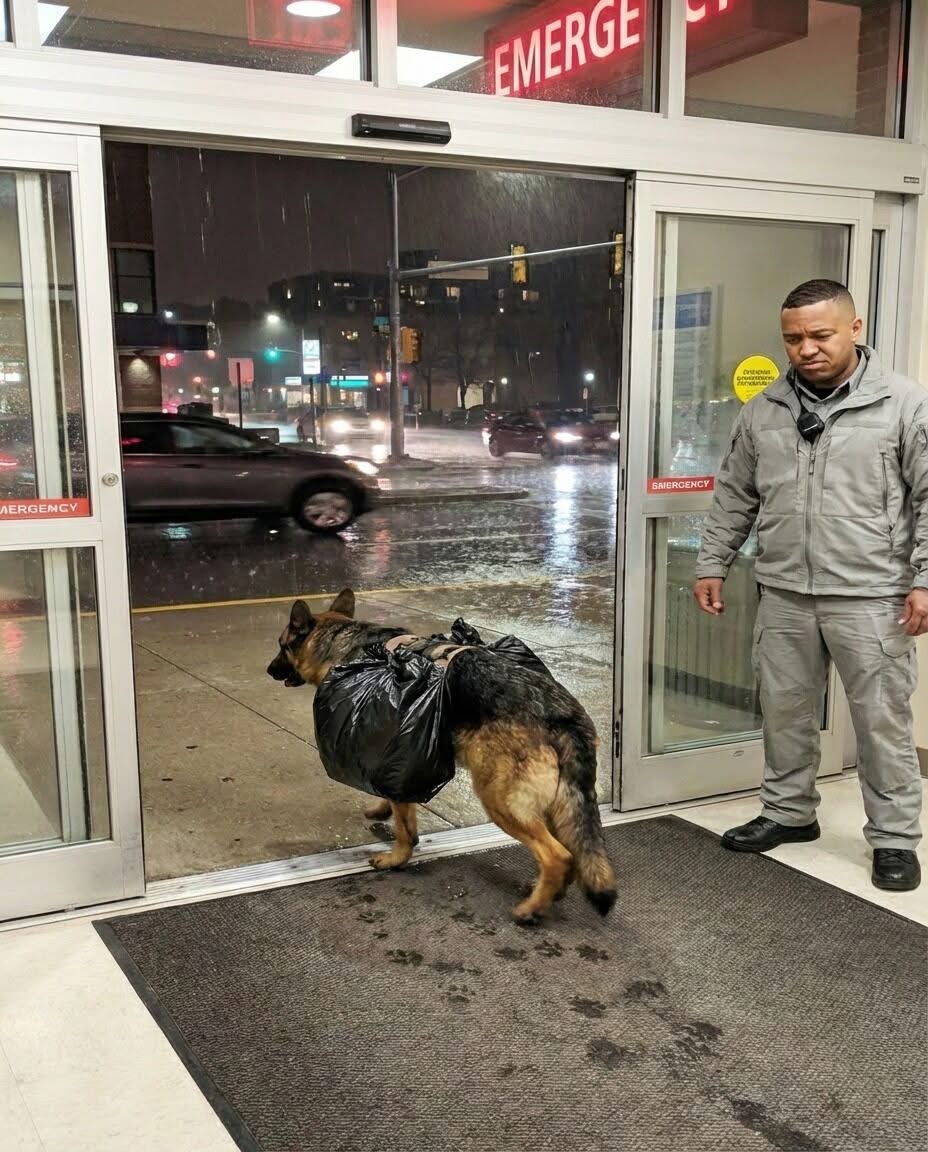
  • The dog ran into the hospital with a huge black garbage bag on its back: the nurses tried to drive it away, until one of them noticed something strange in its behavior

    The dog ran into the hospital with a huge black garbage bag on its back: the nurses tried to drive it away, until one of them noticed something strange in its behavior

    That day, the emergency room was strangely quiet. Outside, heavy rain poured down so hard the streets were almost invisible. Water streaked across the windows, and only a few soaked visitors came through the automatic doors. Inside, the nurses moved slowly—some filling out paperwork, others checking charts—just trying to get through the long shift.
    Then the silence shattered.

    Loud, urgent barking echoed through the room. At first, no one knew where it was coming from. But suddenly, the doors swung open—and a dog ran inside. A large German Shepherd, drenched from the rain, with a heavy black bag strapped to its back.

    The security guard rushed forward.
    “Hey! Stop!”

    But the dog ignored him completely. It moved with purpose, heading straight toward the reception desk, leaving wet paw prints behind.

    One nurse jumped up.
    “Who let that dog in? Get it out of here!”

    Others backed away nervously, waving their hands to scare it off. The guard tried to grab its collar.
    “You can’t be in here!”

    But the dog didn’t retreat. It stood firm, barking loudly, breathing hard—as if it was trying to communicate something. When people got too close, it only stepped aside, never running away. Its eyes looked tense… almost desperate.

    The staff kept trying to drive it out. Someone was about to call for help.It managed to pull the child from the car, placed it in the bag, and somehow made its way through the rain and darkness to the nearest hospital.

    Because of that… the child survived.

    And soon after, the parents were found and brought in time for treatment too.

  • If You Spot a Painted Purple Fence, This Is What It Means

    If You Spot a Painted Purple Fence, This Is What It Means

    In many U.S. states—particularly across the South, Midwest, and rural West—purple paint on trees, fence posts, or rocks isn’t decorative. It’s a legal “No Trespassing” sign.
    This practice, known as the “Purple Paint Law,” is officially recognized in at least 18 states, including Texas, Arkansas, Missouri, North Carolina, Illinois, and Florida. The idea is simple: in large, remote properties (like farms, ranches, or timberland), it’s impractical to post traditional “No Trespassing” signs every few hundred feet. Instead, landowners use vertical purple paint marks as a durable, weather-resistant alternative.While exact rules vary by state, most follow these guidelines:

    Paint marks must be vertical (not horizontal or splattered)
    Length: Typically 8–12 inches long
    Height: 3–5 feet off the ground
    Spacing: Marks placed every 100–1000 feet along the boundary (depending on state law)
    Color: Must be purple (specifically “blaze purple”—a shade visible in most lighting conditions)
    📌 Example: In Texas, under Penal Code §30.06, purple paint marks carry the same legal weight as a “No Trespassing” sign. Ignoring them can result in criminal trespass charges, even if no signs are present.

    ❓ Why Purple?
    Great question! Several practical reasons:

    Highly visible year-round—even in snow, mud, or dense foliage
    Uncommon in nature, so it stands out (unlike red, which could be rust or clay)
    Not used for other property markings (blue = pipeline, orange = survey, etc.)
    Long-lasting paint resists fading better than many colors
    🚫 Does It Apply Everywhere?
    No. If you’re in a state without a purple paint law (like California, New York, or most of New England), purple markings have no legal standing. Always check your local statutes.

    But in states where it is law—ignorance isn’t a defense. Hunters, hikers, and even drone operators have been cited for trespassing based solely on purple paint.

  • Last Known Photos of Icons Before Their Passing – A Look at Their Final Moments A new wave of social media content is drawing attention to the final known photographs of some of the world’s most recognized public figures. These videos present a collection of images captured shortly before their passing, offering viewers a rare and emotional glimpse into the last moments of well-known icons. The content often combines visuals with brief narratives, explaining where and when the photos were taken, as well as the circumstances surrounding the individuals’ final days. For many viewers, these images serve as a powerful reminder that even the most celebrated figures share the same human experiences as everyone else. While the videos aim to inform and engage audiences, experts advise caution when interpreting such content. Not all details shared on social media are fully verified, and some stories may be simplified or dramatized for effect. Despite this, the trend continues to attract widespread attention, as audiences remain interested in the personal and untold stories behind the lives of influential figures.

    A new wave of social media content is drawing attention to the final known photographs of some of the world’s most recognized public figures. These videos present a collection of images captured shortly before their passing, offering viewers a rare and emotional glimpse into the last moments of well-known icons.

    The content often combines visuals with brief narratives, explaining where and when the photos were taken, as well as the circumstances surrounding the individuals’ final days. For many viewers, these images serve as a powerful reminder that even the most celebrated figures share the same human experiences as everyone else.

    While the videos aim to inform and engage audiences, experts advise caution when interpreting such content. Not all details shared on social media are fully verified, and some stories may be simplified or dramatized for effect.

    Despite this, the trend continues to attract widespread attention, as audiences remain interested in the personal and untold stories behind the lives of influential figures.