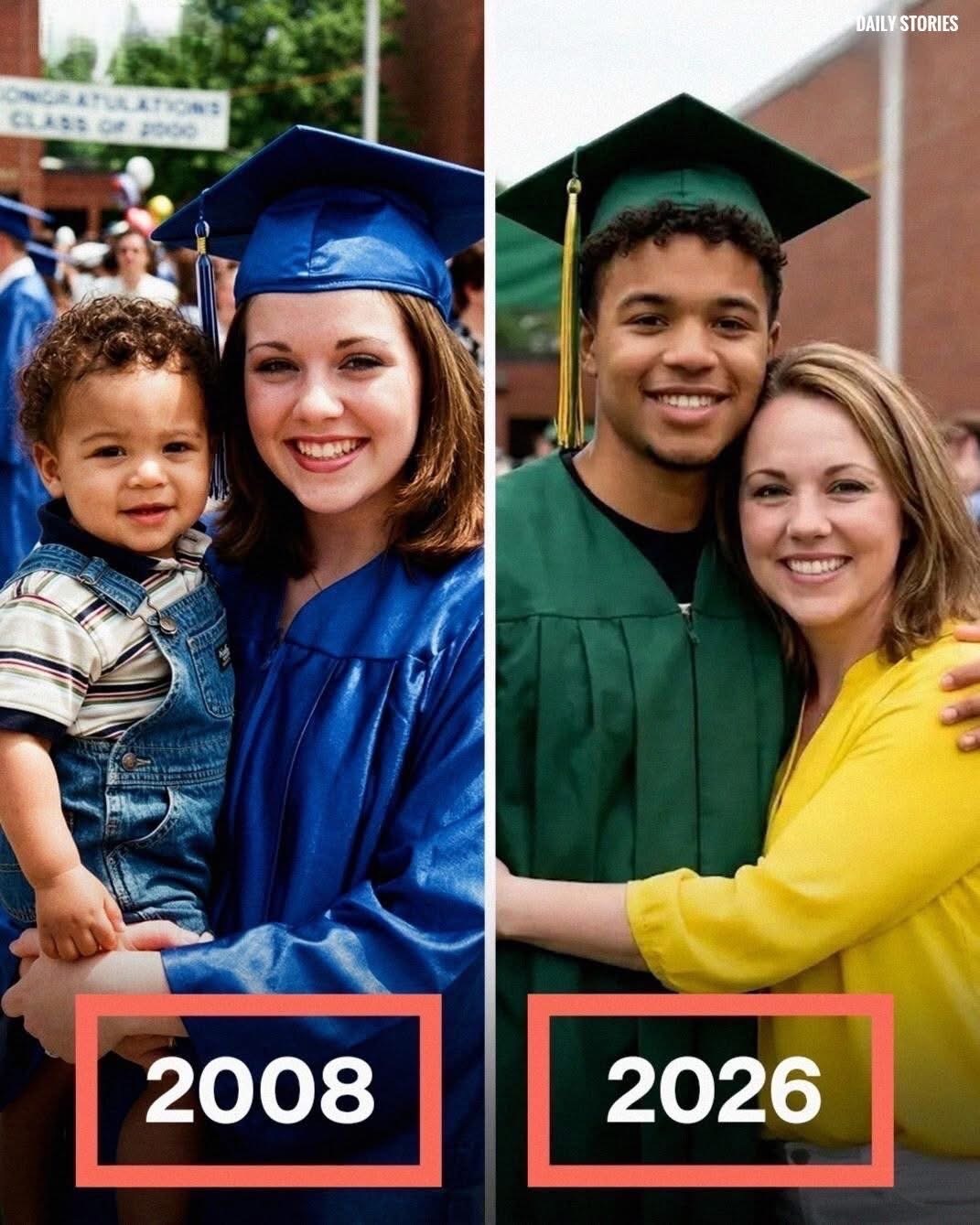
I was standing in my kitchen decorating a simple cake that read “Congrats Leo” when everything changed. My son, now eighteen, walked in looking pale and unsettled, his usual calm replaced with tension. He asked me to sit down, and I immediately sensed that something serious was coming. He explained that he had taken a DNA test, hoping to learn more about the father he had never known. For years, I had believed his father had left us without a word, and that painful belief shaped much of our story. But what Leo showed me next began to shift everything I thought was true.Through the DNA results, Leo had connected with a woman who claimed to be his aunt. At first, I dismissed it, unsure how it could be accurate. But as I read her message, details surfaced that I couldn’t ignore. She explained that Leo’s father had not chosen to walk away. Instead, he had been forced to move away suddenly due to family pressure, losing all contact in the process. According to her, he had tried repeatedly to reach out over the years, but those attempts never made it to us. The version of events I had carried for so long was incomplete.
Blog
-
I Thought He Left—A DNA Test Years Later Told the Truth
-

Brave High School Graduate Silences Mocking Crowd While Holding Newborn Daughter
I attended my son Adrian graduation at age thirty five after raising him alone since I was seventeen. His father abandoned us without warning leaving me to survive through double shifts and quiet struggles. Adrian noticed my exhaustion and deep dedication to keeping our family stable. I believed his senior year meant the hardest days were behind us until his behavior suddenly changed. He began working extra shifts and coming home late looking terrified. Just days before the ceremony he confessed that his girlfriend Hannah had recently given birth to their daughter. He asked me to support his plan to bring the newborn to his graduation to prove he would never abandon his childI sat nervously in the third row with a diaper bag tucked at my feet. When his name was called Adrian stepped out of line and walked directly toward me to collect his baby girl. He tucked his daughter gently against his chest and proceeded toward the main stage.
The surrounding audience immediately began whispering and laughing at the unusual sight. One woman behind me loudly hissed that my son was making the exact same mistakes I had made in my youth. The cruel judgment felt terrible but my son refused to look down or show hesitation. He proudly walked up the steps to accept his diploma while holding his infant daughter with absolute confidence.
-

Every citizen who could be drafted if the US goes to war!
The prospect of a military draft in the United States is often discussed in the abstract, relegated to the pages of history books or the plots of dystopian cinema. However, as global tensions fluctuate in 2026, the reality is that the infrastructure for a national call-to-arms is not a relic of the past, but a meticulously maintained, modern apparatus.
If the United States were to reinstate the draft, the transition would not be marked by immediate chaos or spontaneous mobilization. Instead, it would unfold with a cold, bureaucratic precision. The Selective Service System (SSS) is designed to move with silent efficiency from a dormant database to a full-scale deployment, a process that would fundamentally alter the lives of millions of citizens overnight.
The activation of the draft begins with the “Lottery Phase,” a high-stakes sequence managed by the Selective Service. Contrary to the image of a general call-up, the system follows a strict chronological hierarchy. The primary focus is on men who are in the calendar year of their 20th birthday. If a draft were initiated today, a televised lottery would be held, involving 366 capsules representing every possible birth date. The order in which these dates are drawn determines the “Random Sequence Number” for every registered man. A low number—such as 1 or 15—represents an almost certain summons to service, while a higher number offers a reprieve. Once the 20-year-old bracket is exhausted, the system expands outward to those aged 21, 22, 23, 24, and 25, before finally circling back to 19 and 18-year-olds.